 MartialWise
Which Martial Art Should You Start With? A Beginner's Guide
· Pavika Editorial
Also available in: हिन्दी
There is no single best martial art to start with. There is only a better fit for you. This post gives you a way to choose: start with your goal, learn what striking and grappling mean, then visit a school before you commit. The facts about categories come from one Wikipedia article. The advice is our own and we label it as such.
Start with your goal
The article says martial arts are practised for many reasons: self-defence, competition, entertainment, and physical, mental and spiritual development, among others. It also says training may improve fitness, such as strength, stamina and flexibility, and may support self-esteem and self-control.
So ask yourself what you want most. A few common answers:
- Fitness and a regular habit
- Competition or sport
- Self-defence
- Discipline and focus
- A class for a child
Most people want a mix. Pick the one or two that matter most right now. You can change your mind later.
Strikes, grappling and hybrids
The article splits unarmed martial arts into three broad groups.
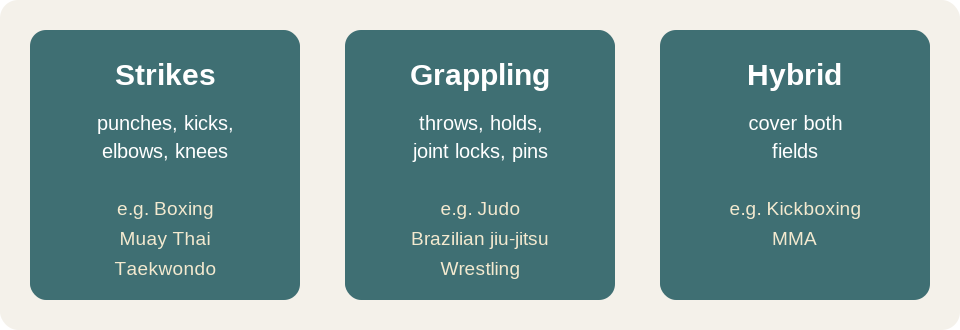
Strikes use punches, kicks, elbows and knees. The article lists boxing, Muay Thai, karate and taekwondo among the arts that use them. If you are curious about two of these, see karate vs taekwondo.
Grappling covers throws, joint locks, chokes, pins and clinch work. The article names judo, wrestling, aikido and Brazilian jiu-jitsu among its examples. For a comparison of two well-known ones, read judo vs BJJ.
Hybrid arts cover both fields. The article gives kickboxing and mixed martial arts (MMA) as examples of modern hybrid styles.
These groups are loose. The article lists some arts in more than one category, and karate appears under both strikes and joint locks. Use the groups as a rough map, not a rulebook.
Matching a goal to a style
This section is our own reasoning, not a sourced finding. Treat it as a starting point.
- Fitness: most training involves drills and conditioning, so the school and the class format may matter more than the style.
- Sport: look at which arts have competitions near you, then check how the classes prepare you for them.
- Self-defence: opinions vary a lot, and we found no neutral source that ranks arts for self-defence. We won’t call any art the most effective. Ask what a school actually teaches and how it tests it.
- Discipline: ask how a school approaches etiquette, structure and focus, since this varies with the instructor.
- Children: the article notes that lighter-contact sparring may be used for children or when heavy contact would be inappropriate. Ask any school what contact level it uses for young students.
Visit before you commit
A style matters less than the people teaching it. Before you pay for months, try to:
- Watch a class, or take a free trial.
- Ask how beginners are looked after, and whether there is a beginners’ group.
- Ask how the class warms up and what happens when someone is injured. Our warm-up post explains what to expect.
- Notice whether the instructor corrects gently, answers questions and lets you set your own pace.
- Check the contact level, the costs and whether you can cancel.
For what happens on the day, read what to expect in your first martial arts class. If karate interests you, our short history of karate is a good place to start.
Safety note
Martial arts involve physical technique. Train under a qualified instructor, warm up before every session, and respect your limits. Tell your instructor about injuries or health conditions before you start.